

Thursday, 6 November 2014
The White Hawk pre-order
Book One of my rebooted series, The White Hawk, is now available for pre-order. The book will be released on Kindle on November 9th, and in paperback shortly afterwards. Just click on the link below the cover image to place your order!

Tuesday, 4 November 2014
The White Hawk reboot
I have plans for The White Hawk, my series following the fortunes of a family of Lancastrian loyalists during the turbulent years of The Wars of the Roses - or The Cousins' War, as it is more fashionably called these days (thank you Philippa Gregory...).
First I aim to re-release new and improved versions of the entire series, with the first two books combined into a single volume. I already have a great new cover for it, again designed by the talented people at More Visual Ltd - see below!

The original series will now be condensed into a trilogy, and Book Three will also include a new short story called The Devil's Due, which acts as a lead-in to the next chapter in the series: I intend to write a whole new series about the Boltons set during the period of the English (or British) Civil War between Charles I and Parliament.
More details on all this to follow shortly. For now, I shall leave you to gaze on the sumptous new cover...
First I aim to re-release new and improved versions of the entire series, with the first two books combined into a single volume. I already have a great new cover for it, again designed by the talented people at More Visual Ltd - see below!
More details on all this to follow shortly. For now, I shall leave you to gaze on the sumptous new cover...
Friday, 17 October 2014
Thunder & Lightning, very very...(etc)
Followers of this blog may have noticed a howling silence in recent weeks - this isn't due to me running out of things to say (fat chance) but a massive storm that hit my part of the country about twelve days ago and burned out our broadband connection.
It was all very dramatic 'rage of the gods'-type stuff, and splendid to listen to from under a blanket in the downstairs cupboard, but has meant that I have had no internet for almost a fortnight. Thankfully we're now hooked up to The Matrix again, so watch this space for news on a revamp of my White Hawk series, and more...
It was all very dramatic 'rage of the gods'-type stuff, and splendid to listen to from under a blanket in the downstairs cupboard, but has meant that I have had no internet for almost a fortnight. Thankfully we're now hooked up to The Matrix again, so watch this space for news on a revamp of my White Hawk series, and more...
Wednesday, 1 October 2014
Leader of Battles reviews
The first two books in the Leader of Battles series are garnering some nice reviews on Amazon and Goodreads. I thought I would post a few excerpts of them on here, as well as an idea for the next sequel(s).


"Wow. This was good. Real good. I try everything out there that falls under the title "Arthurian" ' 90 percent of the time I am disappointed and stop reading. Exceptions being the Crystal Cave series by Stewart, Firelord by Goodwin, Rosemary Sutcliffe, and of course Bernard Cornwells trilogy. You can add Pilling to this short list. This book was awesome. I started it this morning after reading a few pages last night, and finished same day, because I could not put it down. Pilling excels here, and I can't recommend this book enough. If you are into literature in the King Arthur genre, then this will be the book for you."
"An interesting interpretation of a rather obscure period of England's history. Very plausible and descriptive. Something I always wondered about was how much of the Roman civilisation remained after the withdrawal of the legions and this book strives to fill that gap, quite successfully, I might say."
"Not a dull moment and so many discoveries to bring history and a hero to live again. Well done. Bravo."
"So good, so good. This is my favorite subject of historical fiction, done by my favorite author of historical fiction. I only wish it were longer. Pilling is a master story teller. Be done with all the lousy Arthurian garbage available out there, and read these instead. Cannot wait for the third, although I dread the end of this trilogy."
Encouraging stuff! As for future developments, I have in mind a mini-series of novellas titled Warriors of Arthur, linked to the Leader of Battles series but not part of the main trilogy. The novellas are intended to focus on each of Arthur/Artorius' most famous warriors in turn - probably Cei, Bedwyr and maybe Tristan or Drustanus - before I move on to complete the series with the third and final instalment of Leader of Battles. This way I can hope to 'flesh out' my version of Arthur's world and explore it thoroughly before coming to the inevitable end.
First, however, I am taking a break from the world of Post-Roman Britain and having a crack at the British/English Civil war...more details to follow soon!
"Wow. This was good. Real good. I try everything out there that falls under the title "Arthurian" ' 90 percent of the time I am disappointed and stop reading. Exceptions being the Crystal Cave series by Stewart, Firelord by Goodwin, Rosemary Sutcliffe, and of course Bernard Cornwells trilogy. You can add Pilling to this short list. This book was awesome. I started it this morning after reading a few pages last night, and finished same day, because I could not put it down. Pilling excels here, and I can't recommend this book enough. If you are into literature in the King Arthur genre, then this will be the book for you."
"An interesting interpretation of a rather obscure period of England's history. Very plausible and descriptive. Something I always wondered about was how much of the Roman civilisation remained after the withdrawal of the legions and this book strives to fill that gap, quite successfully, I might say."
"Not a dull moment and so many discoveries to bring history and a hero to live again. Well done. Bravo."
"So good, so good. This is my favorite subject of historical fiction, done by my favorite author of historical fiction. I only wish it were longer. Pilling is a master story teller. Be done with all the lousy Arthurian garbage available out there, and read these instead. Cannot wait for the third, although I dread the end of this trilogy."
Encouraging stuff! As for future developments, I have in mind a mini-series of novellas titled Warriors of Arthur, linked to the Leader of Battles series but not part of the main trilogy. The novellas are intended to focus on each of Arthur/Artorius' most famous warriors in turn - probably Cei, Bedwyr and maybe Tristan or Drustanus - before I move on to complete the series with the third and final instalment of Leader of Battles. This way I can hope to 'flesh out' my version of Arthur's world and explore it thoroughly before coming to the inevitable end.
First, however, I am taking a break from the world of Post-Roman Britain and having a crack at the British/English Civil war...more details to follow soon!
Wednesday, 17 September 2014
Real Arthurs
While researching the Leader of Battles series, one thing swiftly became clear: there is very little evidence for a historical 'Arthur'. Unlike Robin Hood, the other big hitter of medieval English/British legend, there is a surprising lack of historical candidates for the real man behind the story. This post will take a look at the tiny handful of credible contenders.
1) Riothamus. Proposed as a viable Arthur by the historian Geoffrey Ashe, Riothamus is still a tantalising mystery. He is described as a 'King of the Brittones', though it is unclear whether this means the Britons of Britain or Britons who had emigrated to Amorica (now Western Brittany). In the year 470 he came to Gaul via the sea (presumably via the Channel) with an army of twelve thousand men to help the Western Emperor, Anthemius, fight the invading Visigoths. Sadly, thanks to the machinations of Arvandus, Prefect of Gaul, the Romans failed to support Riothamus in battle and his army was slaughtered. He is last mentioned fleeing in the direction of a town named Avallon in the land of the Burgundians: famously, the wounded Arthur was supposed to have been carried to Avalon after his last battle.
His name is a problem, but could possibly have been a title, meaning 'High King' or 'Supreme Ruler'. However, Riothamus/Rigotomos was also a personal name, which doesn't help much. Overall, Riothamus remains perhaps the most intriguing of the known historical Arthurs.
2) Lucius Artorius Castus. On the face of it, this man doesn't look much like Arthur at all, despite his middle name. A second century Roman officer, Lucius was a career soldier who served all over the Roman Empire, including a few months (the exact term is uncertain) on one of the forts on Hadrian's Wall in Britain. Also stationed on the Wall were units of armed cavalry called Sarmatians, originally drawn from conquered Roman territory in Scythia and Rus, now parts of modern-day Russia.
The theory goes that Lucius was a cavalry officer in charge of the Sarmatians for a time, and that he led them in a series of smashing victories over invading Picts and other enemies. This left a lingering folk memory in the north of the country, which eventually became the legend of King Arthur and his knights. It's all highly speculative, but at least one big cheese Hollywood producer, Jerry Bruckheimer, found it persuasive enough for a film. 'King Arthur', released in 2004 and starring Clive Owen, Ray Winstone and Keira Knightley, was based on a somewhat garbled version of Lucius' career. The film was not a success, critically or financially, and Lucius has faded from view since.
3) Artúir mac Aedan. Another slightly left-field choice, this man was a prince of Dál Riata, a British or Scotti kingdom in western Scotland, in the late sixth century. His father, Aedan, was King of Dál Riata, and it was prophesied (accurately) that none of his sons would live to succeed him as king. Aedan spent his reign fighting the Picts and Saxons that bordered his territory, and in one of the many battles his son Artúir was killed, probably when he was in his mid-30s: dates for his death range from c. 582 to 596.
David F. Caroll and Michael Wood, among others, argue that Artúir was known as a great warrior during his brief life, and active in the region north of the Wall known as Y Gododdin. The earliest poem to mention Arthur is found in a collection of poetry from this region, so it could be that Artúir was the original inspiration for the warrior, since changed out of all recognition. However, like Riothamus and Lucius Artorius Castus, the connections between Artúir and the legendary king are tenuous at best. The most that can be said is that he did at least bear the right name, and probably fought in an area of the country where 'Arthur' was remembered in poem and song.
4) Ambrosius Aurelianus. Ambrosius, whom I have talked about in recent posts and made the star of the first book of the Leader of Battles series, was a Romano-British hero of the mid-5th century. Gildas, pretty much our only native source for the period, describes him as 'a modest man' and 'the last of the Romans' who by chance happened to be left alive after the Saxons had gutted the country.
In spite of his modesty, Ambrosius managed to rally British resistance and led a campaign of fluctuating fortunes against the Saxon threat. The war ended with the siege of Mount Badon, where the Britons won a victory that led to peace in the land for an entire generation. Annoyingly, Gildas does not name Ambrosius as the leader of the British forces at Badon, though later tradition names the victorious general as Arthur. The fate of Ambrosius is unknown, though there are later stories of him being poisoned by jealous rivals.
And that's about it! There are various other princes and kings named Arthur (or variants) in the records, but details are sparse to non-existent, and the nature of the records themselves provoke endless debate among academics and enthusiasts. Whether the real Arthur will ever step out of the shadows of Dark Age history seems unlikely, but the continued mystery does at least provide writers like myself with an enduring source for fiction.
1) Riothamus. Proposed as a viable Arthur by the historian Geoffrey Ashe, Riothamus is still a tantalising mystery. He is described as a 'King of the Brittones', though it is unclear whether this means the Britons of Britain or Britons who had emigrated to Amorica (now Western Brittany). In the year 470 he came to Gaul via the sea (presumably via the Channel) with an army of twelve thousand men to help the Western Emperor, Anthemius, fight the invading Visigoths. Sadly, thanks to the machinations of Arvandus, Prefect of Gaul, the Romans failed to support Riothamus in battle and his army was slaughtered. He is last mentioned fleeing in the direction of a town named Avallon in the land of the Burgundians: famously, the wounded Arthur was supposed to have been carried to Avalon after his last battle.
 |
| The defeat of Riothamus |
2) Lucius Artorius Castus. On the face of it, this man doesn't look much like Arthur at all, despite his middle name. A second century Roman officer, Lucius was a career soldier who served all over the Roman Empire, including a few months (the exact term is uncertain) on one of the forts on Hadrian's Wall in Britain. Also stationed on the Wall were units of armed cavalry called Sarmatians, originally drawn from conquered Roman territory in Scythia and Rus, now parts of modern-day Russia.
The theory goes that Lucius was a cavalry officer in charge of the Sarmatians for a time, and that he led them in a series of smashing victories over invading Picts and other enemies. This left a lingering folk memory in the north of the country, which eventually became the legend of King Arthur and his knights. It's all highly speculative, but at least one big cheese Hollywood producer, Jerry Bruckheimer, found it persuasive enough for a film. 'King Arthur', released in 2004 and starring Clive Owen, Ray Winstone and Keira Knightley, was based on a somewhat garbled version of Lucius' career. The film was not a success, critically or financially, and Lucius has faded from view since.
 |
| The Once and Future King of legend |
David F. Caroll and Michael Wood, among others, argue that Artúir was known as a great warrior during his brief life, and active in the region north of the Wall known as Y Gododdin. The earliest poem to mention Arthur is found in a collection of poetry from this region, so it could be that Artúir was the original inspiration for the warrior, since changed out of all recognition. However, like Riothamus and Lucius Artorius Castus, the connections between Artúir and the legendary king are tenuous at best. The most that can be said is that he did at least bear the right name, and probably fought in an area of the country where 'Arthur' was remembered in poem and song.
4) Ambrosius Aurelianus. Ambrosius, whom I have talked about in recent posts and made the star of the first book of the Leader of Battles series, was a Romano-British hero of the mid-5th century. Gildas, pretty much our only native source for the period, describes him as 'a modest man' and 'the last of the Romans' who by chance happened to be left alive after the Saxons had gutted the country.
 |
| Clive Owen as 'King Arthur' |
And that's about it! There are various other princes and kings named Arthur (or variants) in the records, but details are sparse to non-existent, and the nature of the records themselves provoke endless debate among academics and enthusiasts. Whether the real Arthur will ever step out of the shadows of Dark Age history seems unlikely, but the continued mystery does at least provide writers like myself with an enduring source for fiction.
Monday, 15 September 2014
Release day!
The second book in the Leader of Battles series, 'Artorius', is now available on Kindle!

"Beware the shadow, and the storm in the north..."
Britain, 470 AD. Ambrosius Aurelanius, the defender of Britannia, is dead, murdered by the son of his greatest enemy. His successor, the heroic General Artorius, is meant to take the crown his predecessor refused and reign as High King. With the Saxons defeated, and the Picts and Scotti driven out, all is set for a golden age of peace and prosperity.
Artorius, however, chooses to step aside and allow another to seize power. The new king, Constantine, despatches Artorius and his army across the sea, to aid the Western Empire in her fight against the Visigoths. Betrayed on all sides, the general narrowly avoids death and returns home to disgrace and exile.
Now reduced to a mercenary, fighting the enemies of British kings, Artorius gathers a band of elite horsemen around him. As Britannia’s enemies slowly recover their strength, and the realm slides back into darkness and ruin, he proves to be the only hope of his people. All the while, a terrifying new threat arises in the north, from the lands Artorius once called home...
Book Two of the Leader of Battles trilogy chronicles the military exploits of Artorius, destined to be remembered as King Arthur, in the treacherous, crumbling world of Sub-Roman Britannia, where every man was a potential enemy, and the sword ruled..."
Leader of Battles (II): Artorius on Amazon US
Leader of Battles (II): Artorius on Amazon US
Tuesday, 9 September 2014
Artorius pre-order
Book Two of the Leader of Battles series, 'Artorius', is now available for pre-order! The book will be officially released on 15th September, so if interested just follow the links at the end of this post to order, and you will receive a Kindle version on that date. The paperback version should be available soon.

As anyone who read Book One of the series will know, 'Leader of Battles' is my attempt at depicting the historical reality behind Arthurian legend, with a reasonably sized dollop of magic and folklore thrown in. Like many other writers, I have set Arthur's career firmly in the Sub-Roman Britain of the mid to late-5th century AD.
Britain or Britannia is caught between the end of the Roman era and the rise of the Saxon kingdoms. The hapless Britons, having grown used to the prosperity and security of Roman rule, have been left to fend for themselves against waves of pagan invaders pouring in from all sides.
Book One chronicled the efforts of the first great Romano-British hero of the era, Ambrosius Aurelianus, and his efforts to stem the tide. This next instalment, as the title suggests, picks up after the death of Ambrosius and focuses on his adopted son, Artúir or Artorius. Artorius is, of course, the man destined to be remembered as the immortal King Arthur, though he bears little resemblance to the romantic king of legend. Instead he is a tough, sometimes brutal soldier, a terror to those who threaten his homeland, and perhaps the one man who can save Britannia from falling into darkness.
The novel tries to depict a realistic image of 5th century Britain, a grim, violent and dirty place, where most of the Roman towns have been abandoned and left to decay as the natives return to the countryside. Roman names and customs are gradually falling into disuse, and the imperial province of Britannia is breaking up into various petty British kingdoms: the Roman province of Venedotia in North Wales, for instance, becomes the Kingdom of Gwynedd.
Some of the locations from the first book reappear, such as the impressive hill-fort Curia (now called Traprain Law) north of Hadrian's Wall, the restored capital Londinium, and Eburucum, capital of Britannia Secunda. Other locations such as Din Eidyn (Edinburgh) an even grander and more dramatic hilltop fortress than Curia, and Arthur's court at Caerleon, are also included. The villains are mostly Saxons, but there is also a terrifying sadist named Gwrgi Wyllt, whom I plucked from an obscure Welsh triad.
Artorius - or General Artorius - and his 'knights' are as realistic as I could make them, a band of late Roman/British horse-soldiers known as buccelari, a term generally describing the mounted retinues of various nobles and kings during this period. Later on, as the British elite ceded more territory to the Saxons and their ilk and retreated into Wales, these retinues became known as a lord's teulu or household guards.
Unlike the heavily armoured knights of later legend, Artorius' men wear light mail and carry throwing javelins, round shields and long-bladed swords with a heavy chopping edge called spathas. Artorius uses them to great effect in hit-and-run attacks on Britannia's enemies. I see him as a talented guerrilla fighter and captain of light horse, more a Cossack than the medieval European king he later became in fiction.
Though increasingly cut off from the remains of the Western Empire on the Continent, Britannia wasn't completely isolated. I have included references to Ricimer, the remarkable Roman general who made and broke Emperors as he pleased, the Western Emperor Anthemius and his successors, and the war in Gaul against the invading Visigoths under the warlord Euric.
Artorius finds himself caught up in the exceptionally nasty, back-stabbing politics of the era, and must use his head as well as his sword (though mainly the latter) to survive...
As anyone who read Book One of the series will know, 'Leader of Battles' is my attempt at depicting the historical reality behind Arthurian legend, with a reasonably sized dollop of magic and folklore thrown in. Like many other writers, I have set Arthur's career firmly in the Sub-Roman Britain of the mid to late-5th century AD.
Britain or Britannia is caught between the end of the Roman era and the rise of the Saxon kingdoms. The hapless Britons, having grown used to the prosperity and security of Roman rule, have been left to fend for themselves against waves of pagan invaders pouring in from all sides.
 |
| Saxon warriors - Arthur's chief enemy |
Some of the locations from the first book reappear, such as the impressive hill-fort Curia (now called Traprain Law) north of Hadrian's Wall, the restored capital Londinium, and Eburucum, capital of Britannia Secunda. Other locations such as Din Eidyn (Edinburgh) an even grander and more dramatic hilltop fortress than Curia, and Arthur's court at Caerleon, are also included. The villains are mostly Saxons, but there is also a terrifying sadist named Gwrgi Wyllt, whom I plucked from an obscure Welsh triad.
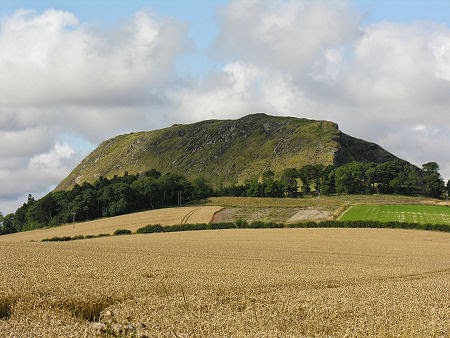 |
| Traprain Law as it appears today |
 |
| Din Eidyn c.5th century AD |
 |
| Late Roman horseman in battle |
Unlike the heavily armoured knights of later legend, Artorius' men wear light mail and carry throwing javelins, round shields and long-bladed swords with a heavy chopping edge called spathas. Artorius uses them to great effect in hit-and-run attacks on Britannia's enemies. I see him as a talented guerrilla fighter and captain of light horse, more a Cossack than the medieval European king he later became in fiction.
 |
| Imperial coin from Ricimer's era |
Though increasingly cut off from the remains of the Western Empire on the Continent, Britannia wasn't completely isolated. I have included references to Ricimer, the remarkable Roman general who made and broke Emperors as he pleased, the Western Emperor Anthemius and his successors, and the war in Gaul against the invading Visigoths under the warlord Euric.
Artorius finds himself caught up in the exceptionally nasty, back-stabbing politics of the era, and must use his head as well as his sword (though mainly the latter) to survive...
Leader of Battles (II): Artorius available as pre-order:
Subscribe to:
Posts (Atom)