Monday, 25 February 2013

...and we have a winner!


I'm very happy to announce - slightly late, for which I apologise - that the winner of the free copy of my book, The Half-Hanged Man, is Stephanie Renee dos Santos! Many thanks to all of you who entered the Hearts Through History Blog Hop competition, and a shiny brand new copy of the book shall be winging its way to Stephanie very soon :)


Saturday, 9 February 2013

The Valentine's Blog Hop!


It's here - "Hearts through History,", the Valentine's Blog Hop, is now live and in progress! I, along with all the other lovely authors listed at the bottom of this post, will be talking about our favourite mushy Valentines-themed anecdotes from history, as well as hosting free giveaways for you, you lucky souls, to win.


Henry VIII (reigned 1509-47) in his pre-pies era

As an author (hem hem) I don't usually 'do' mush, preferring to concentrate on the savage politics of history, and the awesome sword-swinging, But one item did catch my eye the other day. It is number fifteen of a set of private letters King Henry VIII sent to Anne Boleyn while he was in the process of wooing her and divorcing his first wife, Catherine of Aragon.


Anne Boleyn, when she was still the apple of Hal's eye

The letter is of a very personal nature, and is interesting because it gives us some real insight into the King's thoughts, and the depth of his feelings for Anne. Transcribed from the wonky-looking Tudor English, it reads as follows:

"Mine own sweetheart, this shall be to advise you of the great loneliness that I find here, since your departure, for I assure you I think the time longer since your departing now than I was wont to consider a whole fortnight. I think your kindness and my fervour of love causes it for otherwise I would not have thought it possible that for so a little a time could grieve me. But now that I am coming towards you I think my pains are half-released and I am also right well comforted in so much that my book makes substantially for my matter, in the reading whereof I have spent above four hours this day, which causes me now to write this short letter to you at this time by cause of some pain in my head. Wishing myself especially of an evening in my sweetheart's arms, whose pretty breasts I trust shortly to kiss. Written with the hand of him that was, is, and shall be yours by his will..."

It's a charming letter, all the more since it was written by a man generally considered to be a gross tyrant. This was the Henry of the late 1520s/early 1530s, when he was still quite an athletic and handsome man, and before he started to degenerate into the cruel, obese caricature of legend. His decline can perhaps be dated to the moment his marriage to Anne Boleyn turned sour, the heartless and vindictive manner in which he had her framed on all sorts of false charges, and finally executed. The letter above, and the others in the set, give us a precious insight into the man before he became a monster.

As a giveaway I am offering a FREE paperback copy of The Half-Hanged Man, my tale of an English mercenary captain set during the high point of the Hundred Years War. Please see reviews and the blurb etc below:

The Half-Hanged Man on Amazon

You can enter for the giveaway by leaving a comment on this post below. If interested, get posting!

Below is a list of the other Hop participants. Please click on the links to go to the various blogs and websites of the authors listed.

1) Random Bits of Fascination - Maria Grace
2) Me! - David Pilling website
3) Sally Smith O'Rourke
4) Daryholic Diversions (Barbara Tiller Cole)
5) Faith, Hope and Cherrytea
6) Roseanne Lortz
7) Sharon Lathan
8) Debra Brown
9) www.heyerwood.com - Lauren Gilbert
10) Regina Jeffers
11) Ginger Myrick
12 Anna Belfrage
13) Grace Elliott
14) Nancy Bilyeau
15) Wendy Dunn
16) E.M. Powell
17) Georgie Lee
18) Deborah Swift
19) Kim Rendfeld
20) Sherry Gloag
21) Lori Crane
22) Karin Aminadra
23) Heidi Ashworth
24) Stephanie Renee Dos Santos
25) Lauren Gilbert

Wednesday, 30 January 2013

The Cross and the Dragon


Today I have a guest post by Kim Rendfeld to talk about her wonderful historical novel, "The Cross and the Dragon", published by Fireship Press. Over to you, Kim...

A Touch of Medieval Magic

By Kim Rendfeld

One fascinating element of the Middle Ages is how vestiges of paganism coexisted with Christianity. The eighth-century Franks of my debut novel, The Cross and the Dragon, would have a simpler description: magic.

Magic was real to most medieval folk of all classes, including royalty. Through magic and religion, they explained their world and exercised some power over the events in their lives.

My heroine, Alda, wears an iron dragon amulet with a stone from Drachenfels alongside her cross. She believes the long-ago hero Siegfried actually did slay the dragon on a mountain across the river from her Rhineland home. In legend, Siegfried bathed in the dragon’s blood and became invulnerable, except for where a leaf fell on his shoulder.

For my novel, I invented the part about the monster’s blood seeping into the rocks and imbuing them with magical protection, but it is not that far from what medieval people believed.

Magic resided in stones, groves, enclosures, and springs. In a difficult childbirth, a midwife might whisper a spell in the mother’s ear to ease the process. A sick child would be taken to a rooftop while medicinal herbs were cooked and incantations were said. Even priests would turn to divination, spell casting, or interpreted dreams. Manuscripts copied by monks contained magical squares to predict the course of an illness by combining the letters of the patient’s name with the number of the day on which he fell ill.

The Church frowned on sorcery, often blamed for murder and disasters such as a storm destroying a harvest. The penalty for witchcraft could have come straight out of a folktale collected by the Brothers Grimm: being sealed in a cask and thrown into the river. Yet as you can see, the use of protective and healing magic was so widespread, the Church looked away most of the time.

So, while The Cross and the Dragon does not have overt spell-casting as you would find in the Lord of the Rings or Harry Potter series, magic has a presence. The characters believe in it and in otherworldly creatures and act accordingly. I simply couldn’t exclude magic from my story.

Nonfiction Sources
Daily Life in the World of Charlemagne, Pierre Riche, translated by Jo Ann McNamara
Daily Life in Medieval Times, Frances and Joseph Gies


Kim Rendfeld is the author of The Cross and the Dragon, a tale of love amid the wars and blood feuds of Charlemagne’s reign. For more about Kim and her fiction, visit www.kimrendfeld.com.

Tuesday, 29 January 2013

New website!!


I now have a brand new website, courtesy of the brilliant web designer at Fireship Press. Very much a work in progress, but you get the general idea - this will feature information on my new book releases, reviews, research and all sorts :)

http://www.davidpillingauthor.com/

Saturday, 5 January 2013

Creator of the Wolf...


Today I host a guest slot by the very talented Paula Lofting, recent winner of an Indie BRAG medallion and author of the pre-Norman Conquest saga, Sons of the Wolf...


What inspired me to write my novel: My journey
  

Thank you David, for allowing me to do this guest blog on you site. I am Paula Lofting and apart from writing I am a Psychiatric nurse and mum to Connor 16, Catherine 18 and Ron 25. I write historical fiction and I also re-enact the period I am currently writing about, with an organisation called Regia Anglorum. I have always loved history right from a small child when I started reading books like Dawn Wind and The Eagle of the 9th Chronicles by Rosemary Sutcliffe and then as an older child, Leon Garfield and Charles Dickens. Later influences came from Jean Plaidy, Bernard Cornwell, Mary Stewart, Edith Pargetter and Sharon Penman. I’m sure there are many more I have forgotten. After dabbling in different eras, I think I found my niche in the medieval period when I became an avid reader of Sharon Penman’s books. The pre-Conquest era, which is currently my favourite period of interest, really only came to the fore for me about 7 years ago when I attended a re-enactment of the Battle of Hastings and although I knew about this period very well, I hadn’t realised what a tragic story emerges from that fateful day, for King Harold and the indigenous people of England. I wanted to know more and I remembered a book I had read when I was about 17 called The Golden Warrior by Hope Munz. I remembered it to be a good story but back then my obsession with Harold and the 11thc had not begun. That’s also when I got into re-enactment because having been inspired enough to write a book, I also wanted to know what it felt like to live in those days.


So, my long awaited novel that I had wanted to write all my life had begun to form. The reason why it had taken so long to happen was that for much of my life I had been engrossed in other things and my creative streak had been oppressed by some difficult life events. I believe in life, that all things happen when they are meant to and this was the time for me. I was ready.  I piled into loads of reference books and dug out some older books I had hanging around from earlier days, such as Frank Stenton’s Anglo Saxon England and looked for the primary sources in them. My favourite and most treasured acquisition was the Anglo Saxon Chronicles which is a fantastic guide for what happened when. The sad thing about the AS Chronicles is that it was written by some very lazy scribes, either that or the information was not available for them. It does not go into great detail of events and I have had to supplement the information with other works and my imagination.


Before I got too far into my research, I needed to think about what I was going to write about. I wanted to write with Harold as the main character, however I had read the wonderful Harold the King by Helen Hollick which was a new version of his story and because she had written such a brilliant book for him, it was going to be a hard act to follow. So I began searching my mind for a character and a plot and found further inspiration in a book called 1066 Year of the Conquest which was written by a fellow Sussex man, David Howarth.  In it he describes the year of 1066 from the perspective of the ordinary people, particularly focussing on his home village of Little Horsted and the surrounding areas. David Howarth has written many books about history but I believe this was the only one in this era. It is not an academic book, but written very simply, relating the events to how it might have affected the people of these Sussex villages in the 11th c. Through the Domesday book, we are able to identify who owned land in the various villages, hamlets and towns of Sussex.  Horstede (as it was called back then) belonged to a man called Wulfhere who held 5 hides and 30 virgates from King Edward the Confessor. The amount of land Wulfhere held meant that he was a thegn, (pronounced thane) and as such would owe military service to his King for his land.


David Howarth’s writings conjured up images in my mind of a strong warlike man, his longhall, the central feature of a homestead surrounded by a wooden palisade. He lived with his family, and the tenants (his villagers) who shared feasts with him around his hearth. I saw the forest which surrounded the village and the children who ran through it, playing amongst the trees and swimming in ponds damned by rocks. I pictured a man who was returning home from battle with his loyal right hand man to be met with this wonderful scene, the smoke of hearth fires as it billowed out of the apertures of the buildings that lined the pathway to his hall. He waves and smiles as his people come out of their cottages to greet him. The joy he feels when he reaches his gatehouse and crosses himself as he passes by the little chapel, giving thanks to the Lord that he is home at last. He hears the laughter of his children as they run to him with excitement.  Suddenly a story began to unfold in my head on a hot summer’s day and I realised I had my main character, Wulfhere. Nothing was known about him other than that we can find in the Domesday Book. In order to add a tiny bit of realism, I have used the names from the Domesday book for other characters. As with Wulfhere, nothing is really known about them, other than what they owned. So for Wulfhere and his friends, I created lives and personalities and that is how Sons of the Wolf began.

The story centres on Wulfhere mainly and his family but we also see historical characters like Earl Harold Godwinson and his brothers, Edward the Confessor and his wife Edith and various others. Wulfhere is a King’s thegn by hereditary right but he is commended to Harold and as thus is bound by oath and loyalty to serve him. When his oldest daughter, the wilful and headstrong Freyda, embarks on a forbidden relationship with the son of Wulfhere’s adversary, Helghi of Gorde, old enmities between the two men are re-opened and in order to restore peace to his jurisdiction, Earl Harold orders the two men to allow their children to plight their troth, using the ancient philosophy of a woman being the ‘peaceweaver’ in a feud. Although Wulfhere agrees, he is not happy with the situation. The rivers of resentment run deep between him and Helghi and he finds the idea of his daughter wed to the son of his nemesis unpalatable. Urged on by his demanding wife, Wulfhere has to find a way to extricate himself from the contract with Helghi without compromising his loyalty to his lord.

The book is also about battles and skirmishes, love and betrayal. On bloody fields he fights for his life, but sometimes the enemy is closer to home.

You can read more on my Sons of The Wolf blog   http://paulalofting-sonsofthewolf.blogspot.co.uk/

And also http://paulaperuses.blogspot.co.uk/  and http://threadstothepast.blogspot.co.uk/ which is about the Bayeux Tapestry.


Available also in the US and on kindle.

Available also in the US and on kindle.

Wednesday, 2 January 2013

Royalist Rebel!


Today I am hosting a guest slot by Anita Seymour. Her latest book, "Royalist Rebel", set during the English Civil War - a period of history I find absolutely fascinating - is due out on the 17th of January. Take it away, Anita!


Royalist Rebel by Anita Seymour

Intelligent, witty and beautiful, Elizabeth Murray wasn’t born noble; her family’s fortunes came from her Scottish father’s boyhood friendship with King Charles. As the heir to Ham House, their mansion on the Thames near Richmond,
Elizabeth was always destined for greater things.

Royalist Rebel is the story of Elizabeth’s youth during the English Civil War, of a determined and passionate young woman dedicated to Ham House, the Royalist cause and the three men in her life; her father William Murray, son of a minister who rose to become King Charles’ friend and confidant, the rich baronet Lionel Tollemache, her husband of twenty years who adored her and John Maitland, Duke of Lauderdale, Charles II’s favourite.

With William Murray at King Charles’ exiled court in Oxford, the five Murray women have to cope alone. Crippled by fines for their Royalist sympathies, and besieged by the Surrey Sequestration Committee, Elizabeth must find a wealthy, non-political husband to save herself, her sisters, and their inheritance.


Royalist Rebel by Claymore Books, an imprint of Pen and Sword, is released on 17th January 2013


For a little background on the novel, see Anita’s Book Blog

The National Trust Website of Elizabeth Murray’s former home, Ham House, at Petersham near Richmond, Surrey

Anita’s Blog

Sunday, 23 December 2012

A Happy Christmas and New Year

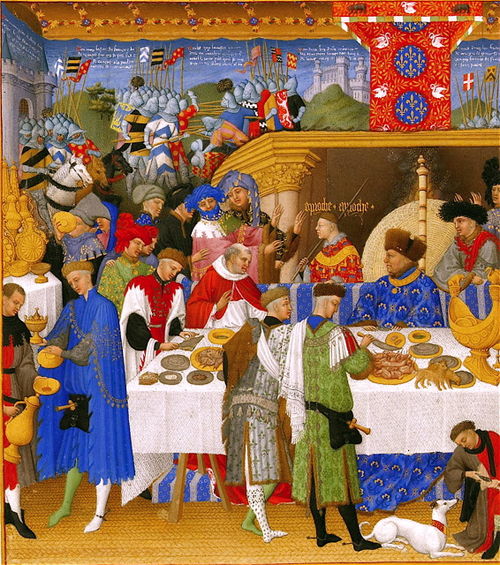
Some merry medievals get stuck into the Yuletide belly-timber

...to one and all! And best wishes for 2013. Let's make it a splendid one :))